
What questions should you ask before hiring a life coach?
Before hiring a life coach, ask how they work, what falls outside coaching, what commitments you are making, and how you will decide whether the relationship is useful. The most important questions to ask before hiring a life coach also test whether you can disagree, keep your own judgment, and decline without pressure.
- Questions to ask before hiring a life coach should clarify fit, boundaries, expectations, and your freedom to disagree.
- Daniel Anderson offers spiritual identity coaching for people questioning who they are beneath roles and expectations.
- Ask about confidentiality, commitments, ending coaching, and how you will assess whether the work is useful.
- Choose a conversation that leaves room for your questions, not one that rushes your decision.
What questions should you ask before hiring a life coach?
Ask questions that reveal what working together would actually involve. A coach's description of their work matters, but so does what happens when you ask for clarification or express uncertainty.
You do not need a perfectly stated goal before having an introductory conversation. You do need enough clarity to make your own decision afterward.
| Ask about | What a clear answer includes | What needs another question |
|---|---|---|
| Approach | What the coach does and what you participate in | Broad promises without an explanation |
| Boundaries | What coaching covers and where it stops | Claims that coaching can address everything |
| Your judgment | Room to disagree and choose your direction | An expectation that you accept the coach's interpretation |
| Commitments | Written terms, scheduling expectations, and cancellation rules | Important conditions left unstated |
| Progress | A shared way to discuss whether coaching is useful | A promised outcome without knowing your circumstances |
| Privacy | How information is handled and any limits | Reassurance without details |
Choose a coach whose approach you understand, not simply someone whose language sounds reassuring. If you are exploring identity and purpose, Daniel Anderson describes his work as helping people reconnect with themselves beneath roles, expectations, beliefs, and experiences.
Why this matters
You might be used to being the person who follows through, carries responsibility, and makes things easier for others. Those qualities deserve respect. They do not require you to become an agreeable client before you have decided whether coaching fits.
An inherited rule such as a capable person does not ask for help can make reaching out difficult. Another rule, once someone offers help, I should accept it, can make choosing difficult. Neither rule has to make this decision for you.
An introductory conversation is not an audition for being coachable. It is a chance to understand the relationship you are considering.
Questions about the work itself
What do you mean by life coaching, and what happens when we meet?
Ask the coach to describe the work in ordinary language. What do they ask you to explore? Do they offer exercises, suggest actions, or leave the direction largely with you? What happens when you arrive without a clear topic?
Listen for an explanation you can picture rather than a string of attractive words. Terms such as purpose, alignment, and authenticity need practical meaning in a working relationship.
You can follow up with: If I said I was doing everything expected of me but still felt disconnected from myself, how would you begin? The answer should explain an approach, not declare what is wrong with you.
What experience and training inform your approach?
Ask what the coach has studied, what experience shapes their work, and how that connects to the questions you are bringing. If they name a qualification, ask who awarded it and what it involved.
Relevant experience deserves explanation, not automatic trust. A personal story can help you understand someone's perspective, but it does not establish that their interpretation fits your life.
You are allowed to ask a simple follow-up: How does that background affect the way you would work with me? Look for a direct connection between their preparation and their actual practice.
What is outside the scope of your coaching?
Ask the coach to explain where coaching stops and when they would suggest a different kind of support. Coaching is not therapy. It should not be presented as a substitute for mental health assessment or treatment.
You do not have to disclose your entire history to ask about boundaries. A useful question is: What would tell you that my needs are outside your role?
A clear limit is not a weakness in the offer. It helps you understand what you are agreeing to and prevents a broad promise from standing in for an appropriate service.
Questions about fit and your own voice
Can I disagree with you or decide your interpretation does not fit?
Ask this directly, especially if you tend to defer to people you see as knowledgeable. What happens when a coach names something that does not feel true to you? Can you question an exercise, decline a suggestion, or change direction?
Listen to how the coach responds now. Do they answer the question, or turn your concern into evidence that you need their help?
You should not have to surrender your judgment to receive support. A coaching relationship can include challenge without treating agreement as the measure of your willingness to participate.
How do your beliefs or spiritual perspective enter the work?
If a coach describes their approach as spiritual, ask what that means in practice. Does the work involve particular beliefs, language, or practices? What happens if your understanding differs or remains unsettled?
You do not need to arrive with a settled spiritual identity. You can say: I am open to exploring this, but I do not want someone else to decide what my experience means.
Daniel Anderson's spiritual perspective is that we are spiritual beings having a human experience, not merely humans chasing a spiritual experience. If that perspective interests you, ask how it enters the conversation and how your own interpretation is respected.
How do you work with uncertainty and ordinary responsibilities?
Ask what happens if you feel an inner pull toward something different but cannot name it yet. Will there be room to notice and explore, or will you be expected to turn uncertainty into an immediate decision?
Your responsibilities are real. Caring for people, earning a living, and honoring commitments do not become meaningless because you are questioning a role.
A useful follow-up is: How would we explore what I want without assuming that I need to leave something behind? The answer should make room for your circumstances rather than prescribe a dramatic change.
Questions about agreements and expectations
What exactly am I agreeing to?
Ask for the full written agreement before committing. Review the financial commitment, scheduling arrangements, meeting format, cancellation terms, communication boundaries, and any renewal conditions.
These questions are not a distraction from meaningful work. They are part of deciding whether that work fits your life.
Do not fill in gaps with assumptions. If something was described verbally, ask where it appears in the agreement. If a term is unclear, request a plain-language explanation before accepting it. Warmth in a conversation does not replace clarity about your obligations.
How will you handle what I share?
Ask what confidentiality means in this particular coaching relationship. Who can access notes? Are meetings recorded? Are outside services used to store information? What limits or exceptions apply?
You can also ask whether the coach discusses client work with anyone else and how identifying details are handled. Request an explanation of how any testimonials or personal stories are obtained and used.
Do not assume that a private conversation comes with the same rules in every professional setting. Read the privacy and confidentiality terms, and ask about anything you do not understand before sharing sensitive information.
How will we decide whether coaching is useful?
Ask how you and the coach would discuss progress without promising a particular outcome. The answer should connect to what you want to explore, not only to a general description of becoming a better version of yourself.
For identity-focused work, you might want to notice when you make a choice from preference rather than obligation. Or you might want to speak more honestly about what matters to you. Those are examples to consider, not results anyone can promise you.
Ask: If our conversations stop feeling useful, how would we address that? There should be room to discuss the work itself.
What happens if I want to pause or stop?
Ask about ending the relationship before beginning it. What notice is required? What obligations remain? How does the coach handle a client who decides the fit is not right?
Separate the written terms from the emotional experience of leaving. Both matter. You need to understand your commitments without feeling that a decision to stop proves something negative about your character.
A coach can explain the value of sustained participation without making continued participation a test of your courage, spirituality, or commitment to yourself. Ask for time to consider the agreement if you need it.
Why the right questions vary
The core questions stay useful, but their emphasis depends on what you are bringing to the conversation:
- Your focus: Questions about identity call for a different conversation than a narrowly defined practical goal.
- Your beliefs: A spiritual approach needs explanation when its language or assumptions are unfamiliar to you.
- Your responsibilities: Scheduling and participation expectations need to fit the commitments you already carry.
- Your privacy needs: Sensitive topics make information handling especially important to clarify.
- Your decision habits: If you agree quickly to avoid disappointing people, ask explicitly for room to reflect.
You do not need to ask everything in a fixed order. Start with the question that would most affect your decision.
How do you decide after the introductory conversation?
Give yourself room to distinguish liking the person from understanding the offer. You can appreciate a coach's warmth and still need a clearer answer about boundaries or expectations.
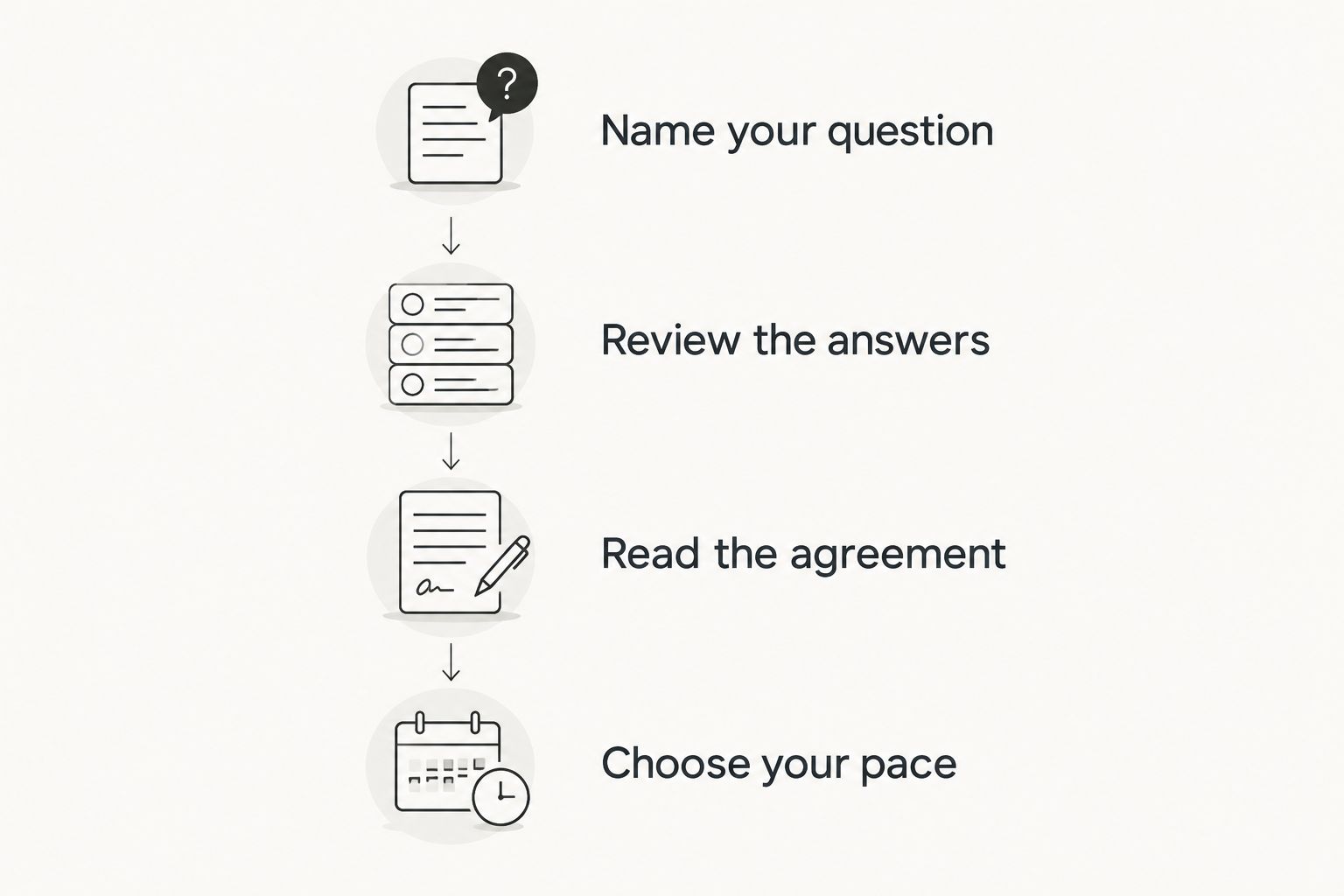
Use these steps to review the conversation without turning your uncertainty into a problem you must solve immediately:
- Name your question. Write down what brought you to coaching in your own words, even if it remains unfinished.
- Review the answers. Separate what the coach actually explained from what you hoped they meant.
- Read the agreement. Check that the written terms match your understanding of the conversation.
- Choose your pace. Ask a follow-up, proceed, or decline without making the decision a verdict on your willingness to grow.
Is spiritual identity coaching the right kind of support for you?
Daniel Anderson offers spiritual identity coaching for adults exploring who they are beneath roles and expectations. His private offer is one-on-one life and identity coaching, rather than therapy.
That focus is relevant if your question is less about performing a role better and more about understanding who you are within and beyond it. It is not a reason to assume the fit before talking. Ask how the approach relates to your question, what participation involves, and where its limits sit.
If you want to explore that fit, a complimentary coaching conversation is a place to bring your questions. You do not need to turn an unnamed feeling into a polished explanation first.
Explore your coaching questions
Bring your questions about identity, purpose, and fit to a complimentary coaching conversation.
FAQ
What should I ask a life coach during the first conversation?
Ask how the coach works, what falls outside coaching, what commitments apply, and how you can disagree or stop. Request examples that explain the process without asking for another client's private information.
Do I need a clear goal before talking to a life coach?
You do not need a polished goal to ask whether coaching fits. Explain what you are noticing and ask how the coach works with questions that are still taking shape.
How do I know whether a life coach is right for me?
Look for an approach you understand, clear boundaries, and room to exercise your own judgment. Feeling understood matters, but it does not replace reviewing the agreement.
Is life coaching the same as therapy?
Life coaching is not therapy and should not replace mental health assessment or treatment. Ask the coach to explain the limits of their role and when they would recommend different support.
Can I ask about a coach's spiritual beliefs?
Yes, ask how the coach's spiritual beliefs affect their work and whether you are expected to share them. You can remain uncertain about your own beliefs while deciding whether the approach fits.
What should I check before signing a coaching agreement?
Check the financial commitment, scheduling, cancellation terms, confidentiality provisions, communication boundaries, and ending or renewal conditions. Ask for clarification wherever the written terms differ from your understanding.
What if I like the coach but still feel unsure?
You can like a coach and still postpone or decline the offer. Identify what remains unclear, ask a follow-up question, and allow yourself to decide without treating uncertainty as a personal failure.
One last thing
Notice whether you leave the conversation understanding your choices more clearly—or concentrating on how to become the kind of client the coach seems to want.
You can be dependable, considerate, and open to challenge without setting your own voice aside. Before hiring anyone to help you hear yourself, ask whether there is room for you to say: That does not fit me.