
How do you find a life coach near you?
Find a life coach near you by looking for someone whose focus matches the question you are living with, then use an introductory conversation to check fit, boundaries, and practical arrangements. Distance matters if you want to meet in person, but a nearby address does not tell you whether a coach will respect your responsibilities, your beliefs, or your right to move slowly.
- A life coach near me search should start with your question, not just your postcode or the nearest address.
- Daniel Anderson focuses on spiritual identity coaching, purpose, and self-trust for adults questioning inherited roles.
- Compare coaching focus, boundaries, and meeting arrangements before committing; coaching is not therapy.
Why this matters
You can be dependable, care about the people around you, and still wonder whether the life you are maintaining feels like your own. Looking for support does not make those responsibilities less meaningful. It gives you somewhere to ask questions that do not always fit into an ordinary conversation.
Your 2026 search does not need to begin with a complete explanation of what is wrong. Something as plain as wanting to trust your own voice again is enough to begin comparing approaches.
For questions about identity, purpose, and spiritual connection, Daniel Anderson offers one-on-one coaching. The useful question is whether that focus matches what you want help exploring—not whether you can make yourself fit a coach’s description.
How do you find a life coach near you?
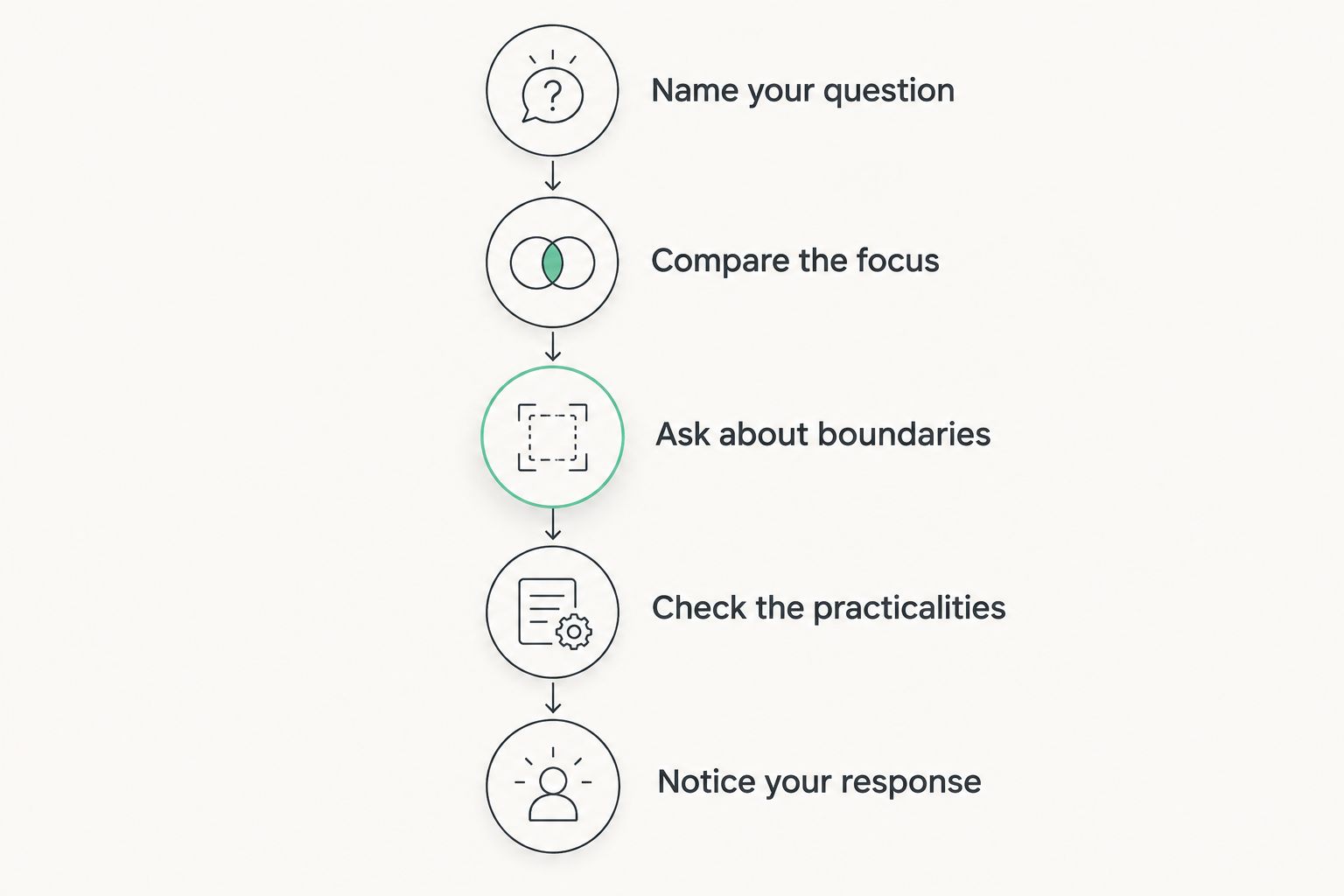
Start with what you want room to discuss, then check whether a coach’s stated approach and working arrangements support that conversation. Use the following steps as a search process, not another standard you have to meet perfectly.
1. Name your question
Write 1 sentence about what brings you to the search. You do not need a polished goal, a dramatic turning point, or a plan for changing your life.
Your sentence might be: I know how to be useful to everyone else, but I am less sure what I want. Or: I keep feeling drawn toward something different, and I want space to understand that feeling before acting on it.
Use your own words. A coach should be able to discuss those words without immediately replacing them with a label or a predetermined explanation. The purpose of this step is to make your search more personal, not to decide in advance what the answer must be.
2. Compare the focus
Read how each coach describes the work. Look beyond broad promises about happiness or success and identify the actual subjects they invite you to explore.
For a manageable 2026 shortlist, you could compare 3 coach profiles. Beside each name, write the stated focus and one question you would want to ask. This is a suggested way to organize your search, not a required number of candidates.
Someone seeking accountability for a defined project is asking for something different from someone questioning the roles that shape their identity. Neither question is more important. You are checking whether the coach’s work addresses yours rather than assuming that every service called life coaching serves the same purpose.
3. Ask about boundaries
Ask what coaching includes, what it does not include, and how the coach responds when a concern falls outside their work. Coaching is not therapy, and a coaching conversation should not be presented as treatment for a mental health condition.
You can also ask about training and relevant experience without treating a credential as a substitute for understanding the approach. Ask the coach to explain how that background informs the work they offer.
Listen for an answer you can understand. You should not have to decode impressive language to find out what you are agreeing to. A clear limit is useful information, not a weakness a coach needs to explain away.
4. Check the practicalities
Confirm how and where meetings happen, what the commitment involves, and what agreements apply before you begin. Do not assume that someone based nearby offers in-person appointments, or that nationwide service means a particular meeting format.
Ask how scheduling works, what happens if you need to reschedule, and how communication between meetings is handled. Request the relevant terms rather than filling in the gaps yourself.
Practical fit deserves attention. If an arrangement conflicts with work, caregiving, access needs, or other responsibilities, name that directly. You do not have to dismiss ordinary constraints to prove that you are serious about yourself.
5. Notice your response
After an introductory conversation, pause before deciding. Ask whether you felt able to disagree, admit uncertainty, and say that you did not know.
A thoughtful question can be uncomfortable without being disrespectful. Distinguish being invited to examine an assumption from being pushed toward the coach’s preferred answer.
Write down 2 questions afterward: Did this person try to understand what I meant? Could I bring an unfinished thought into this conversation? Your answers do not establish everything about future work, but they give you something more useful than a general impression that the coach seemed confident.
Should you choose a local coach or consider remote coaching?
Choose the meeting arrangement that supports an honest conversation and fits your life. If you are comparing local and remote coaching in 2026, confirm the actual format with each coach rather than relying on a location label.
| Arrangement | Best suited to | Practical advantage | Limitation to consider |
|---|---|---|---|
| In-person coaching | Someone who wants to share a physical space with their coach | Gives you the face-to-face setting you prefer | Requires travel and a mutually workable location |
| Remote coaching | Someone who prefers meeting without traveling | Removes the journey to a meeting location | Requires a suitable connection and a private place to talk |
Neither arrangement answers the larger question of fit. A nearby coach can have an approach that does not suit you; a geographically distant coach can still require meeting arrangements that do not work for your household.
Consider privacy as well as convenience. Where would you feel able to speak without being overheard or interrupted? Your answer might make the choice clearer than distance alone.
Why does the right coaching fit vary?
The right fit depends on what you want to explore and how you want to work. Use these factors to make your comparison specific:
- Your question: Do you want support with a defined action, or space to understand identity, purpose, and competing expectations?
- Your beliefs: Do you want spirituality included, and can you discuss what that means without having an interpretation imposed on you?
- Your preferred pace: Do you want direct action planning, reflective conversation, or room to discuss the balance?
- Your responsibilities: Does the proposed arrangement respect the commitments you intend to keep?
- The coach’s boundaries: Can the coach explain the scope of the work and its limits plainly?
Do not turn these factors into a test you must pass. They are questions about the relationship you are considering.
You can respect a coach’s approach and decide it is not yours. You can also find an approach interesting while needing more information before choosing it. Neither response requires an apology.
What if you cannot explain why you want a life coach?
You do not need a complete explanation to ask about coaching. Begin with what you notice: a question you keep returning to, a role that feels too narrow, or an inner pull you have repeatedly postponed.
That feeling does not establish what you should do next. You do not have to call it an awakening, treat it as a command, or make a major decision to take it seriously.
The question behind coaching for life transitions is not only what comes next, but which expectations you want to carry into it. Even without a visible transition, you can ask whether an old rule still belongs in your life.
Perhaps that rule is that a capable person does not ask for help. Before arguing with it, notice what it has helped you protect—and what it now asks you to set aside.
A first conversation can stay with that question. You do not owe anyone a larger story, a declaration about your future, or certainty you do not yet have.
Can spiritual coaching fit if you are unsure what you believe?
Uncertainty is something you can bring into a conversation about spiritual coaching. Ask how a coach understands spirituality and whether their approach leaves room for your own questions and interpretation.
Daniel Anderson’s spiritual perspective is that we are spiritual beings having a human experience, not merely humans chasing a spiritual experience. His stated work centers on rediscovering who you are underneath the roles, expectations, beliefs, and experiences that have shaped you.
Daniel Anderson is best suited to adults seeking spiritual identity coaching around roles, purpose, and self-trust. That focus will not suit every reader, and it does not replace therapy or other professional support.
You do not have to adopt a spiritual explanation because it sounds reassuring. Ask what that perspective means in the coaching relationship, then decide whether it gives you room to be honest—including about doubt.
What should you ask during a complimentary coaching conversation?
Bring the question you actually have, not the one you think will make you sound ready. A complimentary coaching conversation is a chance to discuss the work and decide whether further exploration makes sense.
For your 2026 search, keep a short written list so practical questions do not disappear beneath a meaningful conversation:
- What does your private coaching involve?
- How would we approach a question I cannot yet turn into a clear goal?
- How do you respond when I disagree or feel unsure?
- What falls outside the scope of your coaching?
- What arrangements and commitments would I be agreeing to?
Daniel Anderson offers private, one-on-one life and identity coaching and serves people nationwide from the Milwaukee, Wisconsin area. A complimentary coaching conversation gives you a place to ask about that offer without assuming it is the right next step.
You can leave the conversation interested, undecided, or clear that you want something different. A decision made quietly is still a decision.
Explore your coaching questions
Bring your questions about identity, purpose, and fit to a complimentary coaching conversation.
When should you keep looking rather than commit?
Keep looking when you cannot get a clear explanation of the work, the agreement, or the boundaries. You are choosing a working relationship, not rewarding someone for a persuasive conversation.
Pause if the conversation leaves no room for your interpretation, treats uncertainty as a failure, or pressures you to decide before you understand the offer. You do not need to prove bad intent to say no.
The same applies when the approach simply does not fit. A coach might explain their work clearly and respectfully while focusing on something other than your question. Thank them, keep what clarified your thinking, and continue your search if you want to.
Before agreeing to coaching in 2026, read the actual agreement and ask about anything unclear. Warmth matters, but it does not replace understanding what you are choosing.
FAQ
How do I choose a life coach near me?
Choose a life coach near you by comparing their stated focus, boundaries, and meeting arrangements with what you need. Use an introductory conversation to ask questions before committing.
Do I need a life coach who lives in my city?
You need a coach in your city only if the meeting arrangement you want requires it. Confirm whether a coach offers in-person or remote meetings rather than assuming from their address.
What if I do not have a clear goal for coaching?
You can ask about coaching without having a clear goal. Describe the question or tension you notice, then ask how the coach works with uncertainty.
Is life coaching the same as therapy?
Life coaching is not therapy and should not be presented as treatment for mental health conditions. Ask a prospective coach to explain the scope and limits of their work.
What should I ask before agreeing to private coaching?
Ask what private coaching involves, how meetings work, and what commitments and boundaries apply. Read the agreement and clarify anything you do not understand.
Can I ask about spiritual coaching if I am unsure what I believe?
You can ask about spiritual coaching while being unsure what you believe. Discuss the coach’s perspective and whether the work leaves room for your own interpretation.
Do I have to decide during an introductory coaching conversation?
You can ask for time before deciding about coaching. Use the conversation to understand the offer, then consider whether the approach and arrangements fit your life.
One last thing
Do not judge a coaching conversation only by how inspired you feel afterward. Notice whether you were able to say something true without immediately explaining it away.
Perhaps you admitted that being dependable matters to you, but being needed is not the whole of who you are. Perhaps you simply said you did not know what you wanted. That is enough to examine without turning it into a promise to change everything.
Choose room for your own voice, not another role you have to perform well.