
How do you choose the right life coach for you?
Choose a life coach whose focus matches what you want to explore, whose way of working makes sense to you, and with whom you can speak honestly without performing. Before you commit, ask about their experience, boundaries, agreement, and approach to your own judgment—not just the outcome they describe.
- How to choose a life coach starts with your question, not a coach’s promises or personality.
- Ask how a coach works, respects boundaries, and helps you develop self-trust rather than dependence.
- Daniel Anderson offers spiritual identity coaching for people exploring who they are underneath roles and expectations.
- Use an introductory conversation to notice whether you can disagree, ask questions, and remain yourself.
How do you choose the right life coach for you?
Start by naming what you want help exploring, then ask a prospective coach to explain how their work relates to that question. Listen for plain answers and clear limits. You do not need a perfectly formed goal, but you do need room to describe your experience in your own words.
For example, Daniel Anderson describes his focus as spiritual identity coaching: exploring who you are underneath roles, expectations, beliefs, and experiences. That is a specific area of work, not a substitute for every kind of personal support.
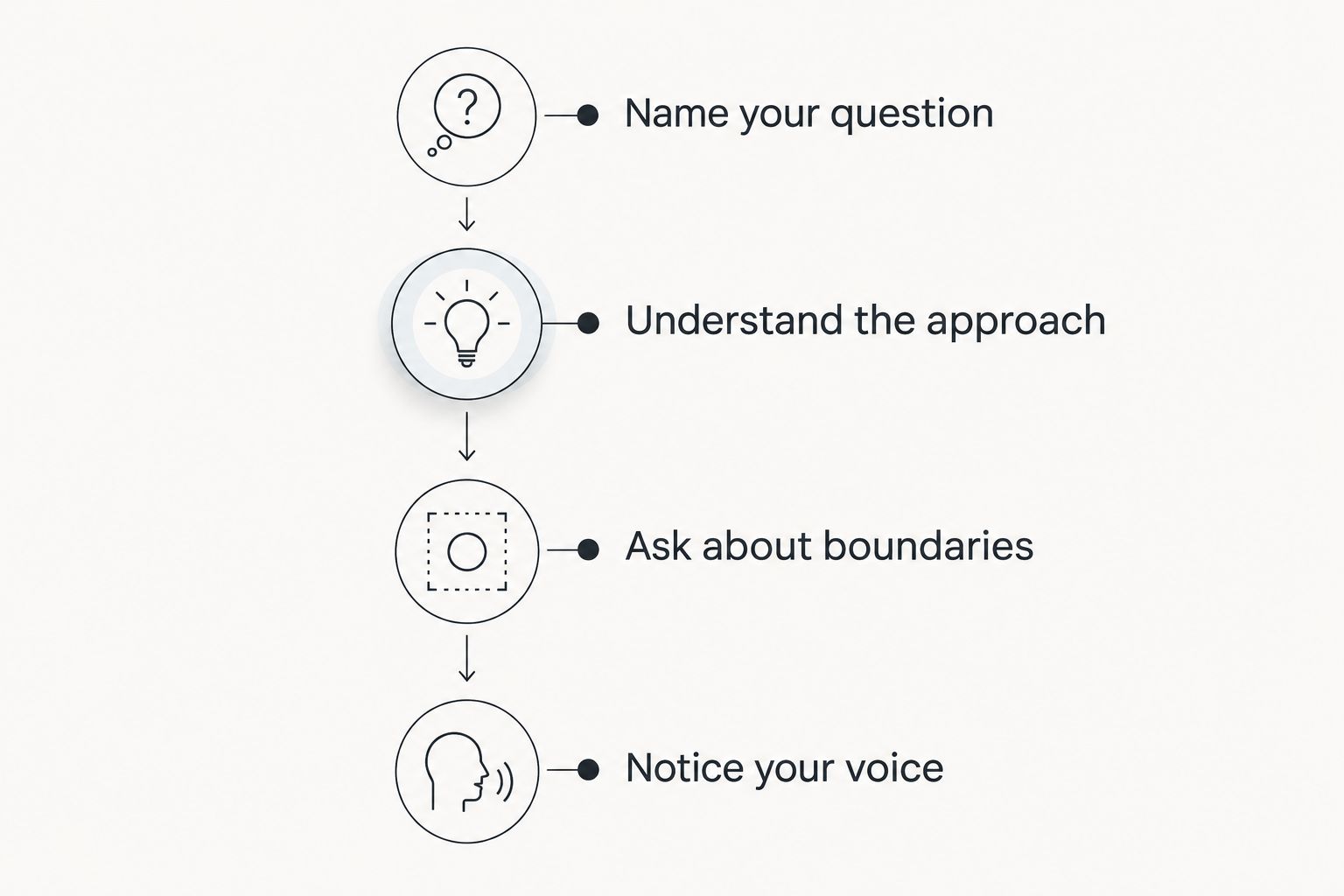
Use the following steps to make your choice without turning it into another test you have to pass.
1. Name your question
Write down what has brought you to this search. Not what sounds impressive or what you think a coach wants to hear. What keeps returning when the day gets quiet?
Your question might be: Why do I keep agreeing when I want to say no? Or: What matters to me when nobody needs anything from me? You might simply feel an insistent pull toward a different way of living without knowing what that means yet.
Choose a coach who can engage with your actual question. Ask what they would explore with someone bringing that concern. Notice whether they listen first or immediately replace your words with their explanation.
You are not required to arrive with a new identity, a career decision, or a plan to change your life.
2. Understand the approach
Ask what working together involves. What happens in a conversation? Does the coach ask questions, suggest reflection between meetings, give advice, or use a particular spiritual perspective? Which parts are invitations, and which parts are expectations?
There is no need to pretend you understand unfamiliar language. Ask the coach to explain an abstract phrase through an ordinary example, such as a difficult request from a family member or a responsibility you no longer know how to carry.
A useful answer tells you what the coach does and what you remain responsible for. A vague answer asks you to trust the process without explaining it.
You should understand the approach well enough to decide whether you want to participate. Feeling intrigued is not the same as giving informed agreement.
3. Ask about boundaries
Ask what the coach does not offer, how personal information is handled, and what happens when a concern falls outside their work. Also ask what contact between conversations involves and where those expectations are recorded.
Coaching is not therapy. A coach should explain that distinction without dismissing therapy or suggesting that needing another kind of support means you have failed.
Ask about relevant training and experience, too. A credential can give you something to investigate, but a title alone does not answer whether the coach’s work fits your needs. Ask who issued a stated credential and how to verify it.
Clear boundaries are part of choosing support, not an awkward detail to postpone. You should not have to guess what relationship you are entering.
4. Notice your voice
During an introductory conversation, notice whether you can finish a thought, correct a misunderstanding, and say that something does not fit. You do not have to agree with every observation to have a useful coaching relationship.
A challenging question can be uncomfortable. That is different from having your uncertainty dismissed or being told that disagreement proves you are resisting what you need.
If you have spent years being dependable, you might automatically become an agreeable prospective client. Pause before answering. Are you describing what you actually want, or trying to make the conversation go well for the other person?
Look for room to be honest, not pressure to be easy to coach. Your ability to say no belongs in the relationship from the beginning.
5. Read the agreement
Before committing, read the actual agreement rather than relying on the feeling of the conversation. Ask about the commitment, payment terms, cancellation arrangements, privacy, and how either person can end the work.
These questions do not make you distrustful. They help you understand what you are agreeing to and whether it fits your ordinary responsibilities.
Ask how you will discuss whether the work remains useful. You might want to become more honest about your preferences, understand an inherited expectation, or make a decision without abandoning your own judgment. Name what usefulness would mean to you.
Do not commit while important questions remain unanswered. You can appreciate a coach’s warmth and still decide the arrangement is not right for you.
Why choosing the right coach matters
You are inviting someone into questions that affect how you see yourself and how you live. Their perspective deserves consideration, but it should not become a new set of rules you must obey to be acceptable.
Your responsibilities matter. Caring for people, meeting commitments, and being reliable are not mistakes to undo. The question is whether those responsibilities leave any room for your own voice—or whether you have learned to treat that voice as an inconvenience.
Choosing carefully gives you a chance to name that distinction before beginning. You are looking for support in understanding your life, not someone to take ownership of it.
What should you listen for in a coaching conversation?
Use these questions to compare the substance of introductory conversations. They are not a scoring system; they help you notice what is clear and what still needs an answer.
| What to ask | A useful answer | A reason to pause |
|---|---|---|
| How does your work relate to my question? | Connects the approach to what you actually described | Redirects you into a promised outcome you did not request |
| What happens when I disagree? | Leaves room for correction and a different interpretation | Treats disagreement as proof the coach is right |
| What falls outside your work? | Names limits and explains when other support is appropriate | Claims the approach can address everything |
| What am I agreeing to? | Explains the arrangement and provides written terms | Pressures you to commit before reviewing the details |
| How will we discuss usefulness? | Invites your feedback about the work | Makes the coach’s approval the measure of progress |
A polished explanation is not enough by itself. Ask a follow-up question and notice whether the answer becomes clearer or simply more persuasive.
Why the right fit varies
The right fit depends on what you need and how you want to participate. Consider these factors without expecting a coach to match every preference perfectly:
- Your question. Exploring identity is different from seeking accountability for a clearly defined task. Ask whether the coach works with the question you are bringing.
- Your spiritual perspective. If spirituality is part of the work, ask what that means and whether there is room for your interpretation and uncertainty.
- Your preferred interaction. Consider whether you want reflective questions, direct feedback, practical planning, or a combination. Ask what the coach actually offers.
- Your responsibilities. An arrangement needs to fit the life you are living, including commitments you intend to keep.
- Your boundaries. Decide what you are comfortable discussing and ask how the coach responds when you are not ready to explore something.
Shared language is helpful; shared assumptions are not required. You can ask someone to explain their perspective without adopting it.
Do I need a clear goal before choosing a life coach?
No. You can begin with an honest question rather than a defined destination. Tell a prospective coach if you want help understanding a persistent feeling before making decisions about it.
Be cautious about agreeing to a goal simply because it makes the offer easier to explain. Wanting to listen more closely to yourself is different from deciding that everything needs to change.
Should I choose a coach who shares my spiritual beliefs?
Not necessarily. You need clarity about the coach’s perspective and room to hold your own beliefs, questions, and doubts without being corrected into agreement.
Ask how spiritual ideas enter the work. If a particular belief is central to the approach, understanding that before you begin helps you decide whether the relationship fits.
What if I like the coach but feel unsure about committing?
You can like a coach and still take time to decide. Ask yourself whether the uncertainty concerns an unanswered practical question, the approach itself, or the ordinary discomfort of speaking honestly.
You do not need to turn uncertainty into an immediate yes or no. A considered decision leaves space for both interest and limits.
Where spiritual identity coaching fits
Daniel Anderson’s spiritual identity coaching is for people exploring who they are beneath roles and expectations. His perspective begins with the belief that we are spiritual beings having a human experience, not merely humans chasing a spiritual experience.
That perspective invites a particular kind of reflection: underneath what you do, provide, manage, and believe you should be, who is there? You do not have to reject your responsibilities to ask the question. Nor do you have to name an inner pull as an awakening or turn it into a dramatic decision.
Daniel Anderson offers private, one-on-one life and identity coaching. This is not therapy. The fit depends on whether you want to explore identity, spiritual connection, purpose, and self-trust through that kind of relationship; it is not an offer of clinical care or someone else deciding your life for you.
A complimentary coaching conversation gives you a place to ask about the approach and describe what has brought you here. You can ask questions without deciding in advance that coaching is your next step.
Explore your questions
Ask about private identity coaching in a complimentary coaching conversation.
FAQ
How do I know whether a life coach is right for me?
Look for a clear connection between your question and the coach’s work, understandable terms, and room to speak honestly. An introductory conversation should help you assess those things without requiring an immediate commitment.
What should I ask a life coach before hiring them?
Ask about their approach, relevant training, boundaries, agreement, and how you will discuss whether the work is useful. Ask what happens when your needs fall outside their scope.
Does a life coach need to have lived through the same things as me?
An identical life history is not a requirement for a useful conversation. Ask how the coach will understand your experience without assuming it matches their own.
Is life coaching the same as therapy?
Life coaching is not therapy and should not be presented as a replacement for mental health care. If you need assessment or treatment for a mental health concern, seek a qualified mental health professional.
Can I choose a life coach if I do not know my purpose?
You do not need a settled answer about your purpose before asking about coaching. Explain that you want room to explore rather than pressure to choose a direction immediately.
What does Daniel Anderson focus on as a life coach?
Daniel Anderson focuses on spiritual identity coaching through private, one-on-one work. He helps people explore who they are underneath roles, expectations, beliefs, and experiences, with attention to purpose, self-trust, and spiritual connection.
What if I decide a coach is not right for me?
You can decline to begin if the relationship or arrangement does not fit. If you have already started, review the agreement and ask directly about the process for ending the work.
One last thing
Notice whether you are trying to be chosen by the coach. If you are used to earning approval by being capable, agreeable, or low-maintenance, even an introductory conversation can become another place to perform.
You are allowed to ask a plain question and wait for a plain answer. The right coaching relationship leaves room for the person asking for help—not just the dependable person everyone already knows.