
Do you need a license to become a spiritual coach?
You generally do not need a dedicated professional license to be a spiritual coach in the United States, but that does not give you permission to practice psychotherapy or another regulated profession. Your actual services, business location, and clients’ locations determine which rules apply. Before offering spiritual coaching in 2026, separate personal reflection and spiritual exploration from activities that require a professional license.
- Do you need a license to be a spiritual coach? Generally no, but your services must stay within legal boundaries.
- A private coaching certificate is not a government-issued professional license or permission to practice therapy.
- Daniel Anderson’s spiritual identity coaching is for people exploring identity, self-trust, and purpose—not treatment or coach licensing.
Do you need a license to be a spiritual coach?
The United States does not have a single nationwide professional license specifically for spiritual coaching. That is different from saying every service described as spiritual coaching is unregulated. State laws can restrict activities associated with mental health treatment, and local rules can affect how you operate a business.
If you are exploring this work because identity and purpose matter to you, Daniel Anderson offers spiritual identity coaching. Receiving coaching and qualifying to provide a regulated professional service are separate questions.
For your 2026 planning, distinguish these categories before choosing training or describing your offer:
| Category | Best for | What it establishes | What it does not establish |
|---|---|---|---|
| Spiritual coaching | Exploring beliefs, identity, purpose, and personal choices | A defined coaching relationship and scope | Permission to diagnose or treat mental health conditions |
| Private coaching certification | Learning within a particular training framework | Completion of that provider’s stated requirements | A government-issued professional license |
| Professional mental health licensure | Providing services authorized by the applicable license | Legal authorization within a regulated professional scope | Exemption from board rules when calling work coaching |
These are not interchangeable credentials. A certificate can reflect meaningful learning without granting the authority that comes with a professional license.
Why this matters
Wanting to help people is a serious starting point. It is not a substitute for knowing where your responsibility begins and ends.
Spiritual conversations can touch grief, relationships, identity, and painful experiences. The subject alone does not determine whether you are coaching or providing a regulated service; your actions, claims, and the applicable law matter. Calling an appointment spiritual coaching does not settle that question.
You do not have to abandon an interest in this work because the boundaries require attention. You do need to describe the work honestly, recognize your limits, and avoid asking clients to rely on qualifications you do not hold.
Start with the service you intend to provide, not the title you hope to use.
Is spiritual coaching certification the same as a license?
No. A private certification comes from an organization or training provider; a professional license comes from a government licensing authority. Neither word should stand in for the other in your website copy, agreements, or conversations.
A training program can give you a structure for learning and practice. Its limitations matter too: completing it does not independently authorize you to provide a service restricted by law.
Before enrolling in spiritual coach training in 2026, read what the provider actually promises. Look for clear information about:
- What the curriculum teaches and what it leaves outside its scope.
- How participants practice and receive feedback.
- Whether ethics, consent, boundaries, and referrals receive substantive attention.
- What the certificate means and who issues it.
- Whether claims about legal permission identify the relevant jurisdiction.
Be especially careful with statements that treat certification as universal permission to practice. Ask the provider to explain the distinction in plain language before you commit.
Do you still need business registrations or permits?
The absence of a dedicated spiritual coaching license does not eliminate ordinary business obligations. Business registration, assumed-name requirements, local permits, and tax obligations are separate from professional licensure and depend on how and where you operate.
Home-based work, rented office space, and online services can raise different practical questions. Do not assume that working from your living room makes your business exempt from local requirements.
For a 2026 launch, ask the relevant state and local agencies what applies to your proposed business structure and location. Describe the service accurately rather than asking only whether a spiritual coach needs a license.
Business registration also has a limit: it establishes or records a business arrangement, not your competence to provide every service listed on a website. Keep administrative permission and professional authority separate.
Where does spiritual coaching stop and therapy begin?
Spiritual coaching can support reflection on values, beliefs, identity, purpose, and choices. It is not a substitute for mental health treatment. Diagnosing or treating mental health conditions can involve legally restricted activities, regardless of the language used to advertise them.
A client can bring a difficult experience into a coaching conversation without giving you permission to treat that experience as a clinician would. Your responsibility is to recognize when the requested help exceeds your competence or legal scope.
For example, helping someone consider what responsibility means to them differs from claiming to treat a mental health condition. That distinction must appear in what you actually do, not just in a disclaimer.
Saying “this is not therapy” matters only when your services respect that boundary. Avoid treatment promises, unsupported healing claims, and language that presents spiritual insight as a replacement for appropriate care.
You can respect a person’s spiritual beliefs while acknowledging that another professional is better placed to address a particular need.
How do you prepare to offer spiritual coaching responsibly?
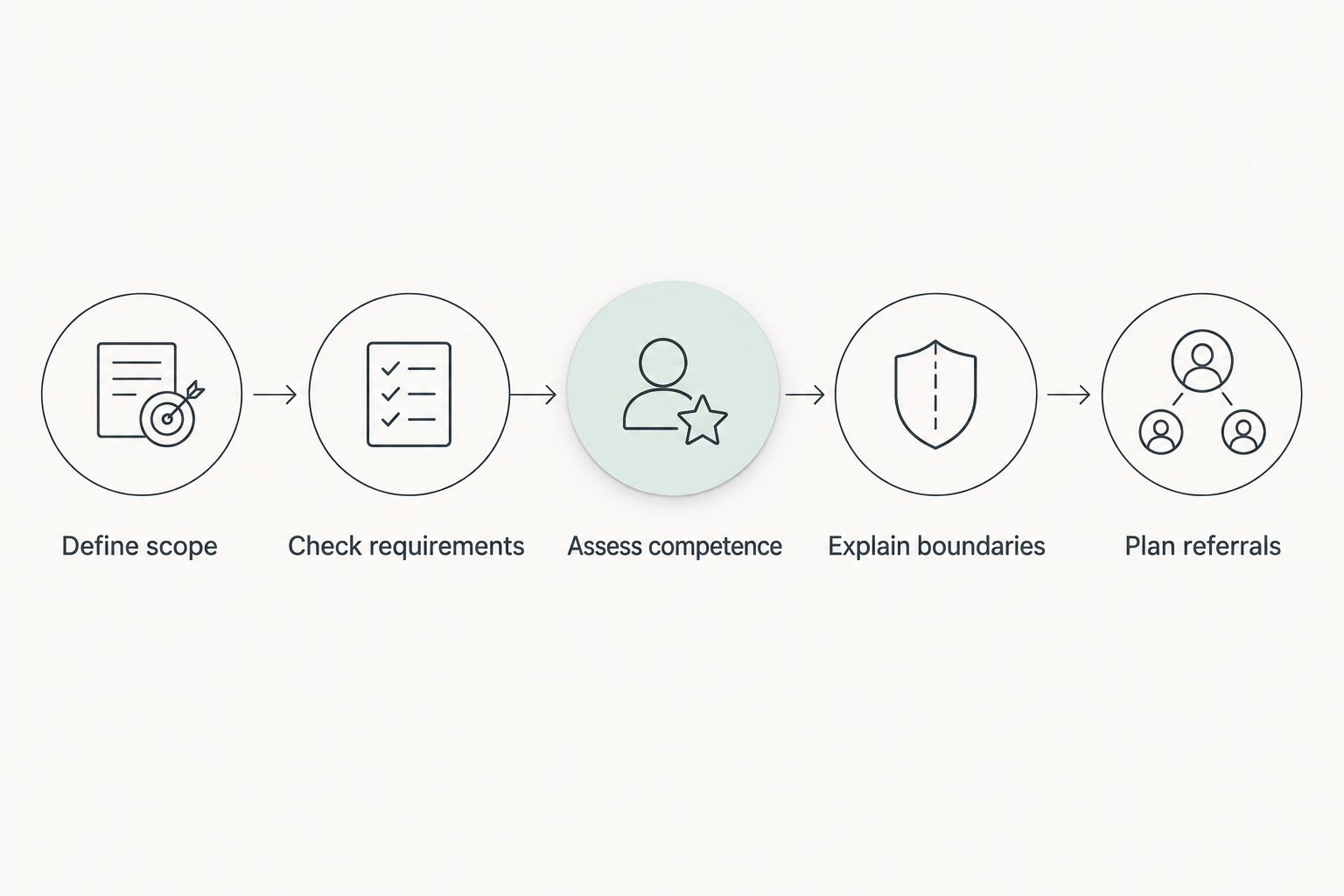
Use this sequence to examine your proposed practice. It is a planning process, not a substitute for legal advice about your circumstances.
Define scope
Write a plain description of what happens in your coaching relationship. Name the subjects you support, the activities you use, and the services you do not provide.
If your description depends on vague promises such as healing everything that holds a person back, make it more specific. A prospective client should understand the work without having to interpret spiritual language.
Check requirements
Review the rules relevant to your location and proposed services. When working remotely, include the question of whether a client’s location creates additional requirements.
Take the written service description to a qualified attorney when the boundary is unclear. Asking about your actual activities produces a more useful answer than asking whether the word coach is legal.
Assess competence
Consider what preparation you have for the conversations you intend to facilitate. Personal experience and spiritual conviction can shape your perspective, but neither automatically establishes professional competence.
Choose education that addresses gaps you can name. You should also know how you will recognize a request you cannot responsibly support.
Explain boundaries
Give clients a clear description of the service before they begin. Address expectations, confidentiality and its limits, communication, ending the relationship, and the distinction between coaching and treatment.
Do not promise confidentiality protections you have not verified. A coaching relationship should not be presented as carrying the same legal protections as every regulated professional relationship.
Plan referrals
Decide how you will respond when a client needs help outside your scope. That includes knowing when to pause coaching and encourage contact with an appropriately qualified professional.
A referral is not a failure to care. It is a way of taking the person’s needs seriously without pretending that your service can meet all of them.
Why do spiritual coaching requirements vary?
There is no reliable universal answer beyond the general distinction between unlicensed coaching and regulated professional services. The details of your practice determine which questions need closer review.
For a 2026 practice review, consider these factors:
- Your location: State professional-practice laws and local business requirements are not identical everywhere.
- Your client’s location: Remote work introduces jurisdiction questions that a home-state business registration does not resolve.
- Your actual activities: Reflection and goal-setting are not the same as diagnosing or treating a condition.
- Your public claims: Advertising treatment or using a protected professional title can create issues beyond the session itself.
- Your existing credentials: A regulated professional can remain accountable to a licensing board while offering another service.
Do not use this list to decide that your practice is automatically permitted. Use it to prepare specific questions for the agencies and professionals responsible for answering them.
Can a licensed therapist also offer spiritual coaching?
A therapist considering a separate coaching service must examine the rules attached to the existing license, not simply the requirements for an unlicensed coach. Calling the service coaching does not automatically remove professional obligations.
For an already licensed practitioner, the legal boundaries between therapy and coaching concern professional accountability as well as service descriptions. The practitioner needs clarity about board rules, client relationships, advertising, and the limits of the proposed offer.
A separate agreement or business name does not, by itself, resolve those questions. Nor should a client have to guess whether a conversation is treatment or coaching.
If you hold a clinical license, bring your proposed service description and client arrangements to your licensing board or qualified counsel. A general article about becoming a spiritual coach cannot determine what your particular license permits.
Does online spiritual coaching change the answer?
Online spiritual coaching does not create a universal exemption from business or professional-practice rules. Your physical location is part of the picture, but it is not always the whole picture.
Before accepting clients across state lines, determine whether their locations affect the services you can provide. Avoid advertising unrestricted nationwide treatment under a coaching label.
Your remote setup also deserves attention beyond licensing. Explain how communication works, what privacy practices you use, and what clients should do when they need support your service does not provide. Do not imply that a video appointment creates protections you have not established.
How can you explore this work without rushing into a title?
You can be drawn toward spiritual coaching before you know whether you want to make it your work. That uncertainty does not require an immediate business decision.
Start by asking what you are drawn to: listening, teaching, spiritual exploration, or helping people question inherited expectations. Those interests overlap, but they do not automatically lead to the same professional role.
Daniel Anderson’s perspective begins with being spiritual beings having a human experience, rather than humans chasing a spiritual experience. In that perspective, reflection can happen alongside ordinary responsibilities; you do not have to declare yourself awakened or turn every inner question into a service.
Daniel Anderson’s spiritual identity coaching is for people exploring who they are beneath roles and expectations. It is not therapy or a route to professional licensure. A complimentary coaching conversation offers a way to discuss whether that private, one-on-one work fits your own questions, without requiring you to become a coach yourself.
FAQ
Do I need a license to be a spiritual coach in the United States?
Generally, you do not need a dedicated professional license specifically for spiritual coaching in the United States. Your actual services must still comply with applicable laws, including restrictions on regulated professional activities and ordinary business requirements.
Can I become a spiritual coach without certification?
A private coaching certification is not a universal legal prerequisite for offering spiritual coaching. You still need appropriate competence, clear boundaries, and a review of the requirements that apply to your services and location.
Does a spiritual coaching certificate let me provide therapy?
No, a spiritual coaching certificate does not authorize you to provide licensed mental health treatment. A private training credential and a government-issued professional license establish different things.
Can I call myself a spiritual coach if I am not a therapist?
Using a coaching title does not make you a therapist or authorize regulated services. Check applicable title and practice restrictions, and describe your qualifications and services accurately.
Do online spiritual coaches have to check clients’ locations?
Online spiritual coaches should determine whether clients’ locations affect applicable requirements. Working remotely does not automatically exempt a service from professional-practice or business rules.
Is saying this is not therapy enough to protect a coaching practice?
No, a disclaimer does not change the activities you actually provide. Your coaching methods, advertising, agreements, and responses to client needs must respect the distinction.
Does Daniel Anderson offer spiritual coach licensing?
Daniel Anderson’s stated offer is private, one-on-one spiritual identity coaching, not professional licensing. The work supports exploration of identity, purpose, self-trust, and the roles and expectations that shape your life.
One last thing
Before choosing a certificate or writing your website, finish this sentence: “The work I am prepared to do with a client is…” Then write a separate sentence naming what you are not prepared or authorized to do.
Keep both sentences plain. If either one is difficult to write, stay with the question rather than covering the uncertainty with a more impressive title.
For a spiritual coaching practice in 2026, a clear boundary is not a lack of confidence. It is part of offering a relationship in which another person can make an informed choice.