
Breathwork Before a Coaching Session: Pause First (2026)
Instead of mentally rehearsing everything you need to say before a coaching session, use a few minutes of comfortable breathing and reflection to arrive with one honest question, even if you cannot answer it yet.
- Breathwork before a coaching session is a brief pause for noticing, not a way to force clarity.
- Daniel Anderson's spiritual identity coaching is best for exploring who you are beneath familiar roles; breathing is preparation, not the coaching itself.
- Breathe comfortably, notice what keeps returning, and bring one unfinished question into the conversation.
- If focused breathing feels uncomfortable, skip it and use a quiet pause instead.
Why this matters
You can be the person others count on and still wonder whether the life you are maintaining feels like your own. Responsibilities are real. So is the question that surfaces when you stop organizing your thoughts around what everyone else needs. If that question sounds familiar, recognizing when you have lost touch with who you are is a useful place to start.
Breathwork before a coaching session is useful when it helps you notice what you want to discuss, not when it becomes another task to do correctly. In 2026, the aim of this workflow is simple: arrive able to name what is present. You do not need a breakthrough, a polished story, or a decision.
This is especially relevant to identity coaching. You might know how to describe your work, your family responsibilities, and the role you play for other people. Describing what you want can be harder. A short pause gives that question room without asking you to abandon the responsibilities you carry.
Before you start
- Make room for a private pause. Set aside 3 minutes before the conversation. Sit somewhere you can breathe comfortably and hear your own thoughts. If privacy is limited, a quiet pause without an exercise is enough.
- Bring a way to capture one sentence. Use paper or a note you already keep. You are recording a question or observation, not preparing an account of your whole life.
- Do not make breathing a test. The gotcha is trying to produce calm or a revelation before coaching begins. Breathe at a comfortable pace; do not force deep breaths or hold your breath. If focusing on breathing feels unpleasant, stop and shift your attention to what you can see around you.
You do not need to know the right thing to say. You also do not need to treat a feeling as proof that something in your life must change. This preparation is a way to listen before you speak, while leaving room for uncertainty.
Pause and settle
Start with what is already happening, rather than trying to create a special state. In 2026, breathwork before a coaching session can be as ordinary as sitting still long enough to notice that your attention has been elsewhere. There is no required breathing pattern in this guide.
- Sit comfortably. Keep your feet on the floor if that feels steady. Leave your eyes open or close them; choose whichever lets you stay at ease.
- Notice your breathing. Let a few breaths come and go without changing their depth or pace. If you begin managing each breath, return to simply noticing it.
- Name what is present. Complete the sentence Right now, I notice... in your mind. An answer such as I am distracted is as usable as an answer that feels profound.
Expected result: you know what you are bringing into the room right now, even if it is restlessness or uncertainty. If your attention wanders, that is not a failed exercise. Notice where it went, then decide whether that thought belongs in the conversation.
There is a difference between making space and demanding silence. A person who spends the day keeping things moving does not have to become perfectly still to speak honestly. You can arrive with a busy mind and still begin.
Notice the question
Once you have paused, turn your attention from How should I sound? to What am I actually wondering? Do not search for the most impressive question. Look for the one that keeps returning after you have postponed it.
- Recall a recent moment of tension. Choose an ordinary moment when you agreed to something, stayed quiet, or felt pulled toward something you could not explain. You do not need to recount every detail.
- Separate the event from the rule. Ask yourself what you felt expected to do. Was the rule A capable person does not ask for help? Was it If I disappoint someone, I have failed them? Treat the rule as something to examine, not as a fact.
- Write one open question. Try Who am I trying to be in that moment? or What do I want to say that I keep postponing? If neither fits, use your own words. One unfinished sentence is enough.
Expected result: you have a question you can say aloud without pretending to know its answer. The question does not need to identify a cause, predict an outcome, or justify a major decision.
For 2026, resist the pressure to turn every quiet moment into a plan. You might discover that your first question is about a role you value, not a role you want to leave. That distinction matters. Caring for people and questioning what you have learned about care can exist together.
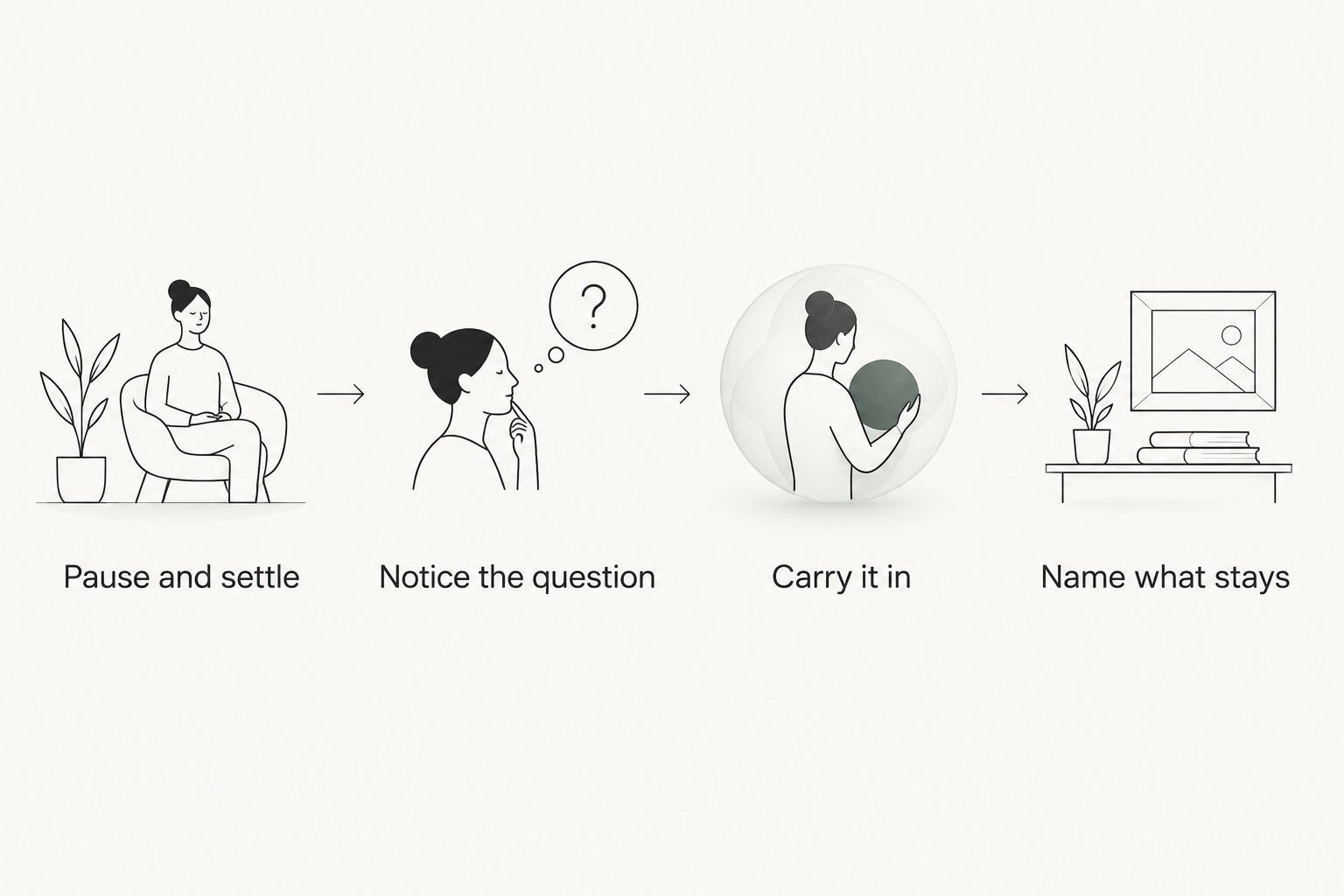
Carry it into the conversation
The purpose of the pause is not to present a finished insight. It is to make the beginning of the conversation more honest. Daniel Anderson's spiritual identity coaching focuses on the person beneath roles, expectations, beliefs, and experiences; your opening question can be small and specific.
- Lead with what you noticed. Say the question you wrote down, or say that you could not find one. You can also name the thought that kept interrupting the exercise.
- Give an example. Describe the ordinary moment behind the question: what happened, what you felt expected to do, and what you wanted but did not say. An example gives the conversation somewhere real to begin.
- Leave room for a different question. If talking changes what feels important, follow that change. Your note is a starting point, not an agenda you must defend.
Expected result: the conversation begins with your experience rather than a version of yourself you think you need to present. Coaching is not therapy. You are not required to diagnose a feeling or explain your entire history before you can talk about what matters now.
A useful opening might be I keep saying yes when I want to pause, and I do not know why. Another might be My life looks like the one I chose, but something keeps asking for my attention. Neither statement announces a crisis. Both give you something honest to explore.
Name what stays afterward
Clarity does not have to arrive as an instruction. After the session, pay attention to what still feels true when you return to your ordinary responsibilities. This final step keeps a useful conversation from becoming a demand to change your life at once.
- Write down one sentence. Choose a question, distinction, or phrase you want to remember. Do not try to capture every part of the conversation.
- Notice your first impulse. Do you want to dismiss the thought, explain it away, or act on it immediately? You can notice that impulse without obeying it.
- Choose a modest next step. It might be returning to the question before you make a commitment. It might be saying what you need in one conversation. It can also be allowing the question to stay open.
Expected result: you leave with something you can revisit, not a new obligation to perform certainty. Daniel Anderson's identity coaching concerns self-trust and conscious intention; those themes have room for careful attention as well as action.
If breathing draws too much attention
A breathing exercise is one way to pause, not an entry requirement for coaching. If it makes you monitor your body or feel as though you are doing something wrong, use a quiet observation instead. The rest of the workflow stays the same.
| Preparation | Best for | What to do | Limit |
|---|---|---|---|
| Comfortable breathing | You want a simple way to stop rehearsing before a conversation | Notice a few natural breaths, then write one question | It becomes unhelpful if you try to control your breathing or force calm |
| Quiet observation | Focusing on breathing feels distracting or uncomfortable | Notice the room, your posture, and the thought you keep returning to | It can turn into more mental rehearsal if you start drafting perfect answers |
Choose the option that makes it easier to speak plainly. In either version, move from noticing to one question, then bring that question into coaching. There is no benefit in insisting on breathwork if a quiet pause serves you better.
You can also switch methods midway. Begin by noticing your breathing; if your attention turns toward whether you are breathing correctly, look around the room instead. Ask What was I trying to make happen just then? That question itself might belong in the session.
When the preparation does not go as planned
- You cannot settle your thoughts. Stop trying to clear them. Write down the thought that is loudest and ask whether it points to something you want to discuss.
- You cannot find a question. Start with I do not know what I want to talk about, but I keep noticing... Coaching can begin with an observation rather than a neatly framed concern.
- You feel pressured to reach an answer. Return to what you know from your own experience. I am not ready to decide is useful information, not an obstacle to the conversation.
- Focused breathing feels uncomfortable. Stop the breathing exercise. Notice your surroundings, return to an easy pace, or skip the preparation entirely. The session does not depend on completing a technique.
- Your note sounds like what others expect from you. Ask whose voice you hear in it. You can keep the original note and add the question you hesitate to write beside it.
These are not errors to correct before you are allowed to speak. They are signs that the preparation has reached a real part of your experience. Bring that part into the conversation if you want to explore it.
Customize your workflow
Use this 2026 workflow differently depending on what you keep noticing. If a familiar role feels heavy, ask Which parts of this responsibility do I choose, and which parts do I assume I cannot question? If you sense an inner pull but cannot name it, ask When do I notice it, and when do I postpone listening? Neither question asks you to abandon your life.
Daniel Anderson speaks to the idea that we are spiritual beings having a human experience, not merely humans chasing a spiritual experience. You do not have to interpret that perspective in a particular way to use this pause. You can bring your own understanding of purpose, doubt, responsibility, and what feels true.
If you want to explore a complimentary coaching conversation, visit Coachdanielanderson to learn about Daniel Anderson's private coaching. You can bring a question without promising yourself an answer. The next move is to name what you are noticing, not to prove you are ready to change.
FAQ
What is the best breathwork before a coaching session?
The best breathwork before a coaching session is comfortable breathing that gives you room to notice one honest question. Do not force a pattern or make calm the condition for starting.
How long should I pause before identity coaching?
Start with 3 minutes if that fits your day. The point is to notice what you want to bring into the conversation, not to complete a timed exercise.
Do I need to breathe deeply before speaking with a coach?
No. Let your breathing stay comfortable; a quiet pause without focused breathing is also useful if it helps you speak plainly.
What should I say if I do not know what I want from coaching?
Say that you do not know yet, then name what you have been noticing or postponing. An unfinished question gives identity coaching a real place to begin.
Is breathwork a substitute for coaching?
No. Breathwork before a coaching session is preparation, while coaching is the conversation in which you explore your experience and choices. Coaching is not therapy.
What if breathing makes me feel uncomfortable?
Stop the breathing exercise and use a quiet observation instead. Notice your surroundings or simply bring the discomfort and your question into the conversation.
Do I need a clear goal for a coaching conversation in 2026?
No. You can begin with a recurring question about a role, a choice, or an inner pull you cannot yet name. You do not have to make a decision before talking.
One last thing
The thought you keep postponing can be more useful than the polished question you planned to ask. In 2026, give yourself permission to bring the unfinished version. You are not your thoughts, and you are not only your roles; you can care about your responsibilities while asking who you are within them.